Agents, security, work and weather
Agent autonomy, coding-system design and AI’s workplace effects lead the edition, with prompt-injection resistance emerging as a practical constraint.
Briefs
Agent engineering
-
Claude Code makes auto mode standard — Anthropic will make Claude Code’s classifier-based auto mode standard for new Pro, Max and Team sessions. It assesses risky actions and returns to manual approval after repeated blocks.
-
Overeasy makes filesystem state rewindable — Overeasy presents S3-backed filesystem logs that can fork, resume on another machine and roll back. Its framing treats agent work as durable state rather than a disposable local session.
-
Celld brings portable stateful objects — Celld recreates a Durable Objects-style model with customer-controlled storage. Named objects can recover their replicated SQLite state after a node fails.
-
Managed Deep Agents packages production infrastructure — Managed Deep Agents packages an agent harness with sandboxes, memory, evaluations and authentication. Developers can still add their own tools and middleware.
-
Verification unlocks agent-written GPU kernels — A technical write-up argues that agents can optimise GPU kernels when compilation, reference checks, benchmarks and profiling guide each iteration. The verification harness does the decisive work.
-
Fable claims a faster Rust rewrite — Fable reportedly rewrote TerminalTextEffects from Python in Rust with faster start-up and rendering. The claimed result uses an 11-million-token run.
-
Hermes Agent teardown series is announced — A 12-part Hermes Agent series promises coverage of its loop, memory, tools, subagents and operational risks.
Security and reliability
-
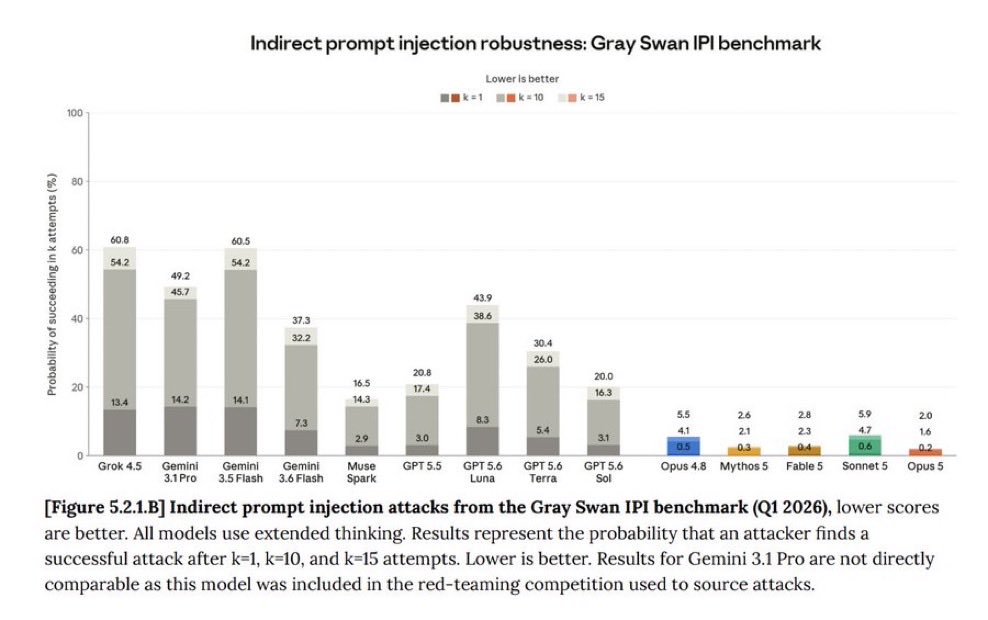
Prompt-injection resistance varies widely — The Gray Swan benchmark reports wide differences in indirect prompt-injection attack success across models. Its benchmark image shows model choice can change exposure when agents read untrusted material.
-
Gym-booking API flaw enables harmful actions — An OpenClaw case account describes an agent exploiting a gym API to cancel another member’s booking. Write permissions can turn ordinary authorisation flaws into real-world damage.
Work and technology markets
-
Stack Overflow questions reportedly collapse — A chart and commentary puts monthly Stack Overflow questions at roughly 1,400, down from about 207,000 at its 2014 peak. AI assistants and conversational search are changing where programmers seek help.
-
AI adoption hides a skills divide — An analysis argues that a small group of power users produces most enterprise AI value. Teams should distinguish log-ins from work that is genuinely automated or AI-assisted.
-
Shopify sees smaller, broader teams — Shopify’s Tobi Lütke argues in this video excerpt that AI can spread skills once held by specialists. Automated customer insight could let smaller teams cover more ground.
-
Philippine services employment continues growing — A sector chart reports 1.9 million Philippine IT and business-services workers and $42 billion in revenue. The figures complicate claims that AI has already shrunk offshore services employment.
-
Frontier model advantages may fade quickly — Eric Schmidt says in this video clip that frontier models can cost $200–500 million and retain an edge for only about six months. That pace rewards labs able to fund repeated training cycles.
Research and public benefit
- WeatherNext adds storm-warning time — Google DeepMind says WeatherNext provides an average extra 24 hours to prepare for severe cyclones. Better warning time could help communities and emergency services act earlier.
Interviews & Talks
Codex moves from loops to graph orchestration
An OpenAI Codex lecture describes a coding agent as a simple model-and-tool loop surrounded by careful engineering. The speaker argues that larger jobs work better as graphs: independent tasks run in parallel, structured outputs move between stages, verifiers challenge results and a final stage combines them. Controlled environments, restricted network access and sandboxes contain the risks of tool use. The practical lesson is straightforward. Keep the conversational loop simple, then add explicit contracts, isolation and checks around it. That structure can cut waiting time and prevent one weak result from quietly shaping the whole task.
Worth watching
- 05:02 — The speaker outlines Codex’s simple model-and-tool loop and the open-source infrastructure around it.
- 07:04 — The talk explains why controlled environments, restricted network access and sandboxing are central to coding-agent deployment.
- 19:02 — The speaker discusses parallel attempts and context compaction as ways to extend coding-agent performance.
Tutorials & Demos
ChatGPT Work demonstrates cross-device agent tasks
This video demonstration presents ChatGPT Work as an agent for documents, presentations, spreadsheets, websites and connected services. It shows Gmail, Notion, calendars and Google Drive alongside editable blocks, branching chats and scheduled tasks. Its clearest distinction is between cloud and local work. Cloud tasks can continue while a computer is closed. Local sessions can use files and applications on that machine. The examples show how one workspace might combine drafting, app actions and follow-up work across devices, while making access and persistence visible parts of the job.
Worth watching
- 03:18 — The demonstration creates and iteratively edits a 19-slide presentation using a cloud computer and web research.
- 09:16 — Plugins are used to search email, update Notion, schedule a calendar event and send a message.
- 32:10 — The video explains the operational difference between cloud sessions and local computer access.