Vehicles, documents and data agents
Nvidia releases an autonomous-vehicle reasoning model, while Replit and Firecrawl show how stronger context and document ingestion can support agents.
Briefs
Frontier Labs and Models
-
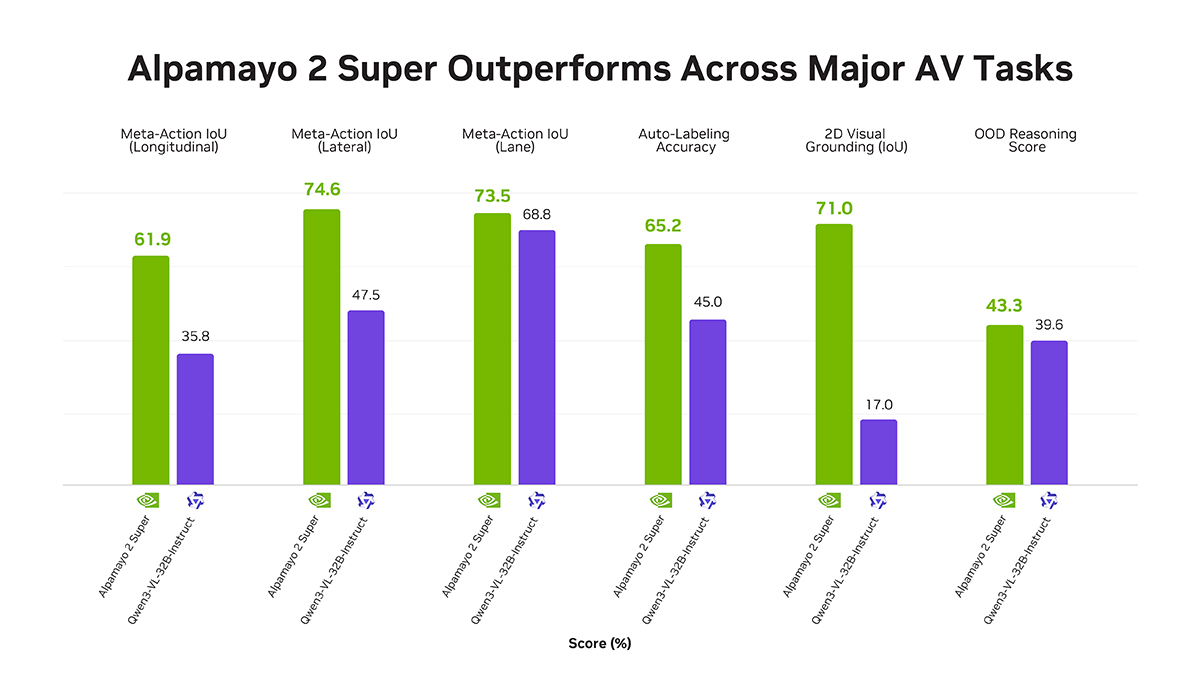
Nvidia launches Alpamayo 2 Super — Nvidia has released the open Alpamayo 2 Super reasoning model for autonomous vehicles. Its supplied charts place it first in five of six listed AV tasks and top a separate reasoning ranking. These benchmarks do not establish safe, reliable driving outside controlled evaluations. Launch announcement AV benchmark chart AV reasoning ranking chart
-
Grok 4.5 refines Blender scenes through visual feedback — Grok 4.5 can control Blender through an MCP bridge, build scenes, inspect renders and correct visible faults such as poor framing or intersecting geometry. The demonstration and technical write-up suggest a quicker route into early 3D work. Unrestricted Blender Python remains a serious host-machine security risk.

Agent Engineering
-
Replit builds a reviewed operational-truth layer — Replit combines databases, documentation and conversations behind a central API, then stores shared definitions and corrections in version control. Humans review changes, and the system checks evidence before agents make claims. Its technical write-up, architecture diagram and announcement describe a reusable company record rather than isolated agent memory. Replit says its internal data agent answers more than 1,000 warehouse-backed questions each week, though those results are self-reported.
-
Firecrawl releases local Markdown document converter — Firecrawl has open-sourced anydoc, a Rust library that converts 14 office and document formats into Markdown locally. The release announcement and repository position it for agent and search ingestion pipelines. Its performance figures use the project’s own benchmark.

Infrastructure and Security
- DeepSeek capacity comes under pressure — OpenCode says heavy user demand has caused capacity problems and traffic limits for DeepSeek models. The capacity update and founder’s account show how automated workloads can strain model APIs. The reported spending and customer scale are unverified.
Tutorials & Demos
Impact Drones demonstrates containerised autonomous interceptors
Impact Drones is developing containerised interceptor drones for defending energy grids, data centres and airports from aerial threats. The product demonstration presents an always-ready system designed to address the price gap between conventional interceptors and cheap hostile drones. It describes drones held charged inside containers, then launched after detection and guided towards a target.
The concept targets sites where a drone incident could disrupt essential services or transport. A lower-cost defensive layer could matter if it works reliably in real conditions. The demonstration does not provide independent evidence of interception success, weather performance or the degree of autonomy used in deployment.
Worth watching
- 00:22 — The founders compare the cost of legacy interceptors with the cheaper drones they are intended to stop.
- 00:30 — The company describes its autonomous containerised defence system for energy grids, data centres and airports.
- 00:40 — The demonstration explains how the system detects, launches and guides an interceptor towards an aerial target.